
If you no longer want to keep your U.S. green card, you’ll generally need to file Form I-407, Record of Abandonment of Lawful Permanent Resident Status. Filing this form officially ends your permanent resident status. Simply letting your green card expire is not enough.
Most people can complete Form I-407 themselves in just a few minutes. However, before submitting it, you should determine whether abandoning your green card has any U.S. tax consequences.
In this guide, we’ll walk you through every section of Form I-407, explain how to submit it, and discuss the tax rules that may apply before you file.
What is Form I-407?
Form I-407, Record of Abandonment of Lawful Permanent Resident Status, is the official form used to voluntarily give up your U.S. green card. By filing Form I-407, you formally notify U.S. Citizenship and Immigration Services (USCIS) that you no longer wish to be a lawful permanent resident of the United States.
Once USCIS accepts your Form I-407, your lawful permanent resident (LPR) status ends. Your Permanent Resident Card (Green Card) is no longer valid, and you’ll generally need a visa or another form of authorization if you wish to visit or move to the United States in the future.
It’s important to understand that an expired green card is not the same as abandoned permanent resident status. Even if your Green Card has expired or you’ve lived outside the United States for many years, you may still be considered a lawful permanent resident until you formally surrender your status by filing Form I-407 or your status is otherwise terminated.
There is no filing fee to submit Form I-407. The form can generally be filed by mail with USCIS, at a U.S. embassy or consulate abroad, or with a U.S. Customs and Border Protection (CBP) officer at a U.S. port of entry. We’ll cover each filing option later in this guide.
The abandonment date is the date USCIS accepts Form I-407 or the date it is accepted by a U.S. consular or immigration officer. That date is important because it generally determines when your U.S. tax residency ends.
What Are the Tax Implications of Abandoning Your Green Card?
That depends on whether you’re considered a long-term resident.
Green Card Holder for Less than 8 of the last 15 tax years
If you’ve held a green card for less than 8 of the last 15 tax years, abandoning your green card is generally straightforward. You’ll file your final U.S. tax return for the year you abandon your green card, and the U.S. expatriation rules don’t apply. You have two options:
Option 1: Dual-Status Return
File Form 1040 for the portion of the year you were a U.S. tax resident, reporting your worldwide income. Then file Form 1040-NR for the remainder of the year, reporting only your U.S.-source income.
Option 2: Full-Year Resident Return
In some cases, you may elect to file Form 1040 as a full-year U.S. resident. This requires reporting your worldwide income for the entire year, but it may allow you to claim the standard deduction and file jointly with a U.S. citizen or resident spouse.
You may also need to file additional international information returns. For example, if the total value of your foreign financial accounts exceeded $10,000 at any point during the year, you’ll generally need to file an FBAR (FinCEN Form 114). If you meet the FATCA reporting thresholds, Form 8938 may also be required.
Held a green card for 8 of the last 15 tax years
If you’ve held a green card for 8 of the last 15 tax years, you’re considered a long-term resident for U.S. tax purposes. In that case, abandoning your green card is treated similarly to renouncing U.S. citizenship.
Before filing Form I-407, you’ll generally need to:
- Bring your U.S. tax filings up to date. If you haven’t filed U.S. tax returns for several years, you may still be able to become compliant through the Streamlined Filing Compliance Procedures, which allow many eligible taxpayers living abroad to catch up on their tax filings without facing IRS penalties.
- Certify on Form 8854 that you’ve complied with your U.S. tax obligations for the previous five tax years.
- Determine whether you’re a covered expatriate and whether the U.S. exit tax applies.
Although the exit tax often sounds intimidating, most long-term residents don’t actually owe it. Read our Complete Guide to the U.S. Exit Tax to learn when it applies and why most expatriates never pay it.
How Long-Term Residents Can Reduce Exit Tax Exposure
If you live in a country that has an income tax treaty with the United States, it may be possible to claim a treaty tie-breaker position. In some situations, this can prevent you from being treated as a long-term resident for expatriation purposes, potentially avoiding Form 8854 and the exit tax rules altogether.
Because this planning must be completed before filing Form I-407, we recommend speaking with one of our cross-border tax accountants first.

How to Complete Form I-407 Step by Step
Most people can complete Form I-407 in less than 15 minutes. Before you begin, download the latest version of the form from the USCIS website and have the following information ready:
- Your Permanent Resident Card (Green Card)
- Your A-Number
- Your passport
- Your current mailing address
- The date you last departed the United States
We’ll walk through each section of the form below.
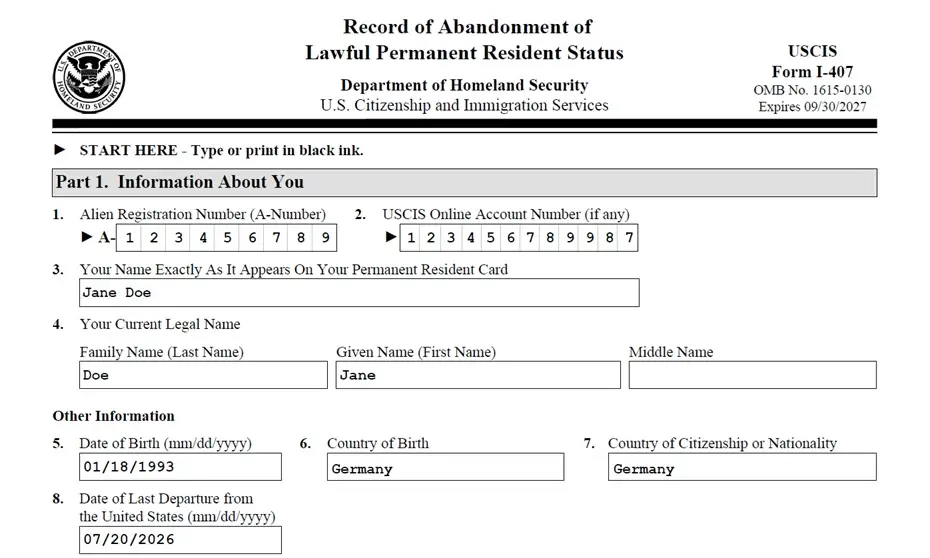
Part 1 – Information About You
Part 1 collects your personal information and records your decision to voluntarily abandon your lawful permanent resident status.
Item 1 – Alien Registration Number (A-Number): Enter your A-Number exactly as it appears on your Green Card or USCIS correspondence.
Item 2 – USCIS Online Account Number: If you have a USCIS Online Account Number, enter it here. If you don’t have one, simply leave this field blank.
Items 3–6 – Personal Information:
Complete these fields using your current legal information.
Enter:
- Your full legal name
- Date of birth
- Country of birth
- Country of citizenship or nationality
Your answers should match your immigration documents whenever possible.
Item 7 – Date of Last Departure from the United States: Enter the date you most recently left the United States.
If you aren’t certain of the exact date, review your passport stamps or travel records before completing the form.
Foreign Mailing Address
Provide the mailing address where you want USCIS to send any future correspondence.
If you live outside the United States, enter your complete foreign mailing address, including:
- Street address
- City
- Province or state
- Postal code
- Country
Use an address where you can reliably receive mail after your Green Card has been surrendered.
Returning Your Green Card
Form I-407 asks whether you’re returning your Permanent Resident Card.
If you still have your Green Card, select Yes and submit it together with your application.
If you no longer have it, select No and indicate why.
Common reasons include:
- Lost
- Stolen
- Destroyed
If you still possess an expired Green Card, you should generally return it with Form I-407.
Other USCIS Documents
If you’re returning any additional immigration documents issued by USCIS, list them here.
These may include:
- Reentry permits
- Refugee travel documents
If you’re not returning any additional documents, simply leave this section blank or enter “None” if instructed.
Certification and Signature
Read the certification carefully before signing.
By signing Form I-407, you’re confirming that you voluntarily wish to abandon your lawful permanent resident status and understand the consequences of doing so.
If you’re mailing the form directly to USCIS, sign and date it before sending it.
If you’re filing at a U.S. embassy or consulate, check whether you’re required to sign the form in front of a consular officer. Some embassies have different procedures.
Part 2 – Interpreter
Leave Part 2 blank unless someone translated the form or interpreted it for you.
If an interpreter assisted you, they must complete and sign this section.
Part 3 – Government Use Only
Do not complete Part 3.
This section is completed by USCIS, a U.S. consular officer, or a Customs and Border Protection officer after your Form I-407 is submitted.
How to File Form I-407
Once you’ve completed Form I-407, the final step is submitting it to the appropriate U.S. government office. At the same time, you’ll generally need to surrender your Permanent Resident Card (Green Card) and any other USCIS-issued immigration documents, such as a reentry permit.
There are three ways to file Form I-407.
Option 1: Mail Form I-407 to USCIS
Most applicants who are living abroad choose to mail Form I-407 directly to USCIS.
Send your completed form to:
USCIS
Attn: I-407
31 Rochester Avenue
Portsmouth, NH 03801
USA
Include the following with your application:
- Your completed and signed Form I-407
- Your physical Permanent Resident Card (Green Card)
- Any USCIS-issued reentry permits or refugee travel documents, if applicable
Before mailing your package, make copies of everything for your records, including both sides of your Green Card.
We also recommend using a mailing service that provides tracking, such as certified mail or an international courier. This allows you to confirm that USCIS has received your application.
Typical processing time: Approximately 4 to 8 weeks, although processing times may vary.
Option 2: Submit Form I-407 at a U.S. Embassy or Consulate
If you’re living outside the United States, you may also submit Form I-407 at a U.S. embassy or consulate.
Before visiting, check the embassy’s website to see whether an appointment is required, as procedures vary by location.
Bring the following documents with you:
- Your completed Form I-407
- Your Green Card
- Your valid passport or other government-issued photo identification
In many cases, a consular officer will review your form, witness your signature if required, collect your Green Card, and provide confirmation that you’ve voluntarily abandoned your lawful permanent resident status.
Typical processing time: Many embassies provide confirmation during your appointment, although some forward the application to USCIS for final processing.
Option 3: Submit Form I-407 at a U.S. Port of Entry
If you’re entering the United States and have decided to give up your green card, you can also submit Form I-407 to a U.S. Customs and Border Protection (CBP) officer at a U.S. port of entry.
Bring:
- Your completed Form I-407
- Your Green Card
- Your valid passport
The CBP officer will collect your Green Card and process your request to abandon your lawful permanent resident status.
Keep in mind that once you’ve surrendered your Green Card, future trips to the United States will generally require you to qualify for entry under another immigration status, such as the Visa Waiver Program (ESTA) or a visitor visa, depending on your citizenship.
Typical processing time: Immediate.
Which Filing Method Should You Choose?
For most green card holders who permanently live abroad, mailing Form I-407 directly to USCIS is the simplest and most convenient option.
If you prefer to submit the form in person or have questions about your documentation, filing through a U.S. embassy or consulate may be a better choice.
Submitting Form I-407 at a U.S. port of entry is generally reserved for individuals who are already traveling to the United States and wish to surrender their green card upon arrival.
Common Mistakes When Filing Form I-407
Although Form I-407 is relatively straightforward, we regularly see applicants make avoidable mistakes that can delay processing or create unnecessary tax issues.
The most common mistakes include:
- Assuming an expired green card automatically ends lawful permanent resident status.
- Filing Form I-407 before understanding whether the long-term resident rules apply.
- Forgetting to sign the form.
- Entering an incorrect A-Number.
- Returning the form without the Green Card or explaining why it isn’t available.
- Using an outdated version of Form I-407.
- Forgetting to keep copies of the completed form and supporting documents.
- Assuming filing Form I-407 also satisfies their final U.S. tax filing requirements.


