
Frequently asked questions
Renouncing U.S. Citizenship

How to Renounce U.S. Citizenship?
Renouncing U.S citizenship is a formal, irreversible process governed by the Immigration and Nationality Act and administered by the State Department. You must complete the entire renunciation process in a foreign country in front of a consular officer abroad. It cannot be done by mail or within the United States.
Here’s a step-by-step breakdown of how to renounce your U.S. citizenship:
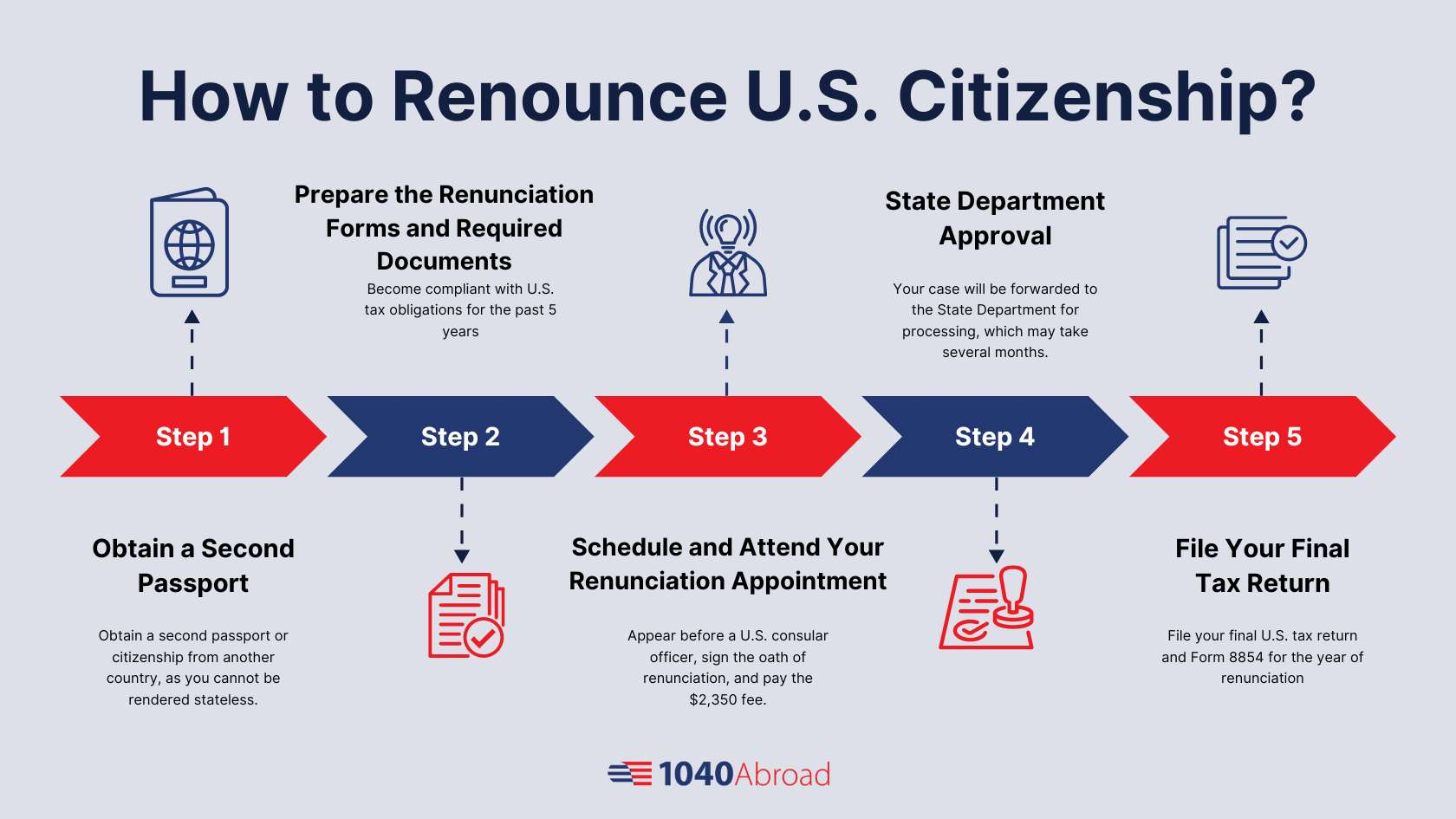
STEP 1: Obtain Another Citizenship
Before you renounce US citizenship, you should already hold a foreign citizenship and a valid foreign passport. The legal requirements are designed to prevent statelessness. If you do not have another nationality, your request to renounce citizenship may be denied.
Many Americans abroad pursue foreign naturalization before starting the renunciation process. Becoming a citizen of a foreign state ensures you can continue to live, work, and travel normally after your loss of nationality.
STEP 2: Ensure Tax Compliance
Before you renounce U.S citizenship, you need to be up to date with your U.S. tax filings.
In practice, this often means:
- Filing the U.S. tax returns needed to establish five years of tax compliance
- Filing six years of FBARs when catching up on prior FBAR obligations
If you are not compliant, you risk being classified under covered expatriate status, which can trigger the exit tax and increase your overall tax liability.
Most individuals need to complete these filings before moving forward with their renunciation appointment.
Our Renunciation Package covers this stage. It includes preparing all required tax returns and FBARs needed before you renounce citizenship, filed under an IRS amnesty program that removes penalties for previous non-filing. Once everything is submitted and you are compliant, you can move forward with your renunciation appointment without delays.
STEP 3: Prepare Required Documents and Forms
You must gather all required documents before your interview appointment. These typically include:
- Your U.S passport
- Your birth certificate
- Your foreign passport
You will also need to complete official forms, including:
- DS-4079 (in some cases, to assess a potentially expatriating act)
- DS-4080 (Oath of Renunciation)
- DS-4081 (Statement of Understanding)
These forms confirm your intent to give up United States nationality and acknowledge the consequences.
STEP 4: Schedule and Attend Your Appointment
You must schedule a renunciation appointment with a U.S. embassy or consulate in a foreign country. You must appear in person before a consular officer or diplomatic or consular officer.
During the in person interview, the consular officer will:
- Confirm your identity
- Review your documents
- Ensure your decision is voluntary
- Explain the consequences of losing U.S citizenship
You will then sign a formal declaration and take the oath of renunciation.
Your loss of nationality is triggered when you take the oath of renunciation, not when the certificate is issued later by the State Department.
If you want to understand what to expect during the process, see our guide on How to Prepare for a U.S. Renunciation Appointment.
STEP 5: Pay the Renunciation Fee
You must pay a government fee of $450 to the State Department at the time of your appointment. This is required for all U.S citizenship renunciation cases.
STEP 6: State Department Review
After your appointment, your case is sent to the Department of State for review. This is largely a formal step.
Once processed, you will receive your certificate of loss, which confirms your loss of nationality. This is your official proof that you are no longer a U.S citizen.
STEP 7: File Your Final Tax Return
This is the final step that takes you out of the U.S. tax system.
Even after you renounce U.S citizenship, you are not considered fully exited for tax purposes until this is completed with the IRS.
You must:
- File your final tax return
- Submit Form 8854
- Certify that you have been compliant for the previous 5 years
Form 8854 is required to certify that you have met your tax obligations for the previous five years. It is also used by the IRS to determine whether you are subject to the exit tax rules.
You can read a full breakdown here: Form 8854 requirements, filing steps, and exit tax rules.
Once this step is completed, you cease to be a U.S. person for tax purposes and your federal tax obligations come to an end.
If you need assistance with this step, our Final Tax Return together with Form 8854 covers the preparation and filing required to properly close out your U.S. tax obligations.
How Much Does It Cost to Renounce U.S. Citizenship?
The government fee to renounce U.S citizenship is $450.
This was reduced from $2,350 on April 13, 2026 and is paid at your renunciation appointment with a consular officer in a foreign country.
See full update: U.S. renunciation fee drops to $450 in April 2026.
If you need to become compliant with the IRS before renouncing, the total cost will increase. This typically involves filing 5 years of U.S. tax returns and 6 years of FBARs.
Compliance costs vary depending on your situation. For example, our Renunciation Package is $2,600, which brings you into the required tax compliance to renounce U.S citizenship, while the Final Tax Return is $700, which completes your tax obligations and removes you from the U.S. tax system.
Some individuals may also be subject to an exit tax, depending on their net worth and tax liability.
Do I Still Have to Pay U.S. Taxes If I Renounce My Citizenship?
No, once you renounce US citizenship and properly complete your tax obligations, you generally no longer have to file or pay U.S. income taxes. However, it’s important to note that U.S. estate tax and gift tax may still apply to certain assets or transfers, such as U.S. real estate or gifts made to U.S. persons, even after expatriation. Understanding these ongoing obligations is crucial for expatriates.
To exit the U.S. tax system, you must:
-
Be fully tax compliant
-
File your final tax return
-
Submit Form 8854 to the Internal Revenue Service
Once this is done, your U.S. filing requirement ends.
If you continue to have U.S.-source income after you renounce U.S. citizenship, you may still have limited tax obligations in the United States. If you do not, you generally have no further filing requirements.
Renouncing U.S. citizenship on its own does not end your tax obligations. It is the completion of your final filings that does. However, past tax obligations do not disappear automatically and must be resolved before you fully exit the U.S. tax system.
What Is Exit Tax?
The exit tax is a one-time tax that may apply when you renounce U.S citizenship.
It is based on a “deemed sale” of your worldwide assets. This means the IRS treats your assets as if they were sold the day before your loss of nationality, even if you did not actually sell anything. The tax is then calculated on the unrealized gains.
When Does Exit Tax Apply?
The exit tax applies when you meet any of the following:
- Your net worth is above $2,000,000
- Your average income tax liability exceeds the IRS threshold
- You are not fully tax compliant
If you meet any of these, you are treated as a covered expatriate and are subject to the exit tax rules.
See full criteria: Covered Expatriate vs Non-Covered Expatriate.
This does not automatically mean you owe tax. The actual exit tax is only assessed if your unrealized gains exceed the available exemption amount.
To avoid being treated as a covered expatriate, you must keep your net worth below $2,000,000, stay within the IRS income threshold, and be fully tax compliant for the five years before you renounce U.S citizenship.
How Is Exit Tax Calculated?
The calculation is based on:
- The value of your worldwide assets
- The gain on those assets (purchase price vs current value)
- An exemption applied to the total gain
Only the capital gains are taxed. The IRS treats it as if all your worldwide assets were sold before your loss of nationality, and taxes the gain under specific rules.
For 2026, the exit tax exemption is $890,000. This means only gains above this amount are subject to tax.
Certain assets, such as pensions and tax deferred accounts, are treated differently.
Most individuals who are not significantly above the $2,000,000 threshold do not end up paying exit tax, as their total unrealized gains fall below the exemption amount.
For a full breakdown, see Exit Tax Explained: The Cost of Renouncing U.S. Citizenship
Expatriation Planning
If your net worth is above $2,000,000, it is important to plan before you renounce citizenship.
In some cases, individuals reduce their asset base before renouncing. See How to reduce your asset base before renouncing U.S. citizenship.
Can I Still Visit the U.S. After Renouncing?
Yes. After you renounce U.S citizenship, you can still visit the United States.
However, you will be treated as a foreign national.
This means:
-
You must travel using a foreign passport, as you can no longer use a US passport after renouncing your citizenship
-
You must enter under the Visa Waiver Program or apply for a visa
-
You no longer have the right to enter the U.S. as a United States citizen
Only United States citizens have the automatic right to enter the U.S. without a visa; former citizens must follow standard entry procedures.
Your ability to visit depends on your foreign country of citizenship and its visa arrangements with the United States.
In most cases, there are no issues visiting the U.S. after your loss of nationality, as long as you meet the standard entry requirements.
Renouncing U.S citizenship does not prevent you from traveling to the United States. It simply changes your status to that of any other foreign visitor.
Can I Get U.S. Citizenship Back After Renouncing?
No. Renouncing U.S citizenship is permanent.
Once you complete the renunciation process and your loss of nationality is approved by the State Department, you are no longer a U.S citizen.
If you want to return in the future, you must go through the standard immigration process like any other foreign national. This may involve applying for a visa and, if eligible, obtaining naturalization again.
There is no way to simply reverse a decision to renounce citizenship.
How Long Does It Take to Renounce U.S. Citizenship?
The timeline to renounce U.S citizenship depends mainly on embassy availability and processing by the State Department.
In most cases:
-
Scheduling your renunciation appointment with a consular officer in a foreign country can take a few weeks to several months, depending on location
-
After your appointment and oath of renunciation, the State Department reviews your case
-
You will receive your certificate of loss (Certificate of Loss of Nationality) typically within a few months
Your loss of nationality is effective on the date you take the oath of renunciation, not when you receive the certificate.
The overall process is usually driven by appointment availability rather than complexity of the case.
What Happens After I Renounce U.S. Citizenship?
After you renounce United States citizenship, you are treated as a foreign national and become a former citizen.
As a former citizen, you lose all rights and protections associated with American citizenship, including voting rights and consular protection abroad. You can no longer use a U.S. passport, vote, or live and work in the United States without immigration permission. Any future travel must be done using a foreign passport under standard entry rules. Additionally, future generations cannot inherit U.S. citizenship if they are born after your renunciation.
On the tax side, you still need to complete your filings with the IRS. This includes submitting your final tax return and Form 8854. Once that is done, your U.S. filing requirement ends. If you do not have U.S.-source income going forward, you generally have no further obligations.
You will receive a certificate of loss from the State Department, which confirms your loss of nationality.
From that point onward, you are no longer part of the U.S. tax system or treated as a U.S. person for tax purposes.
For a detailed breakdown, see What happens after you renounce U.S. citizenship.
What is an Expatriating Act?
An expatriating act refers to specific actions, known as statutory expatriating acts, that can potentially cause a person to lose their U.S. citizenship as defined by the Immigration and Nationality Act (INA) and the Internal Revenue Code (IRC). According to U.S. law, certain statutory expatriating acts include:
-
Obtaining Naturalization in a Foreign Country:
-
INA Section 349(a)(1): If you obtain naturalization in a foreign country after the age of 18, it is considered a statutory expatriating act.
-
Taking an Oath of Allegiance to a Foreign State or Other Formal Declaration:
-
INA Section 349(a)(2): Making a formal declaration of allegiance to a foreign state after the age of 18, such as taking a foreign oath, making an affirmation, or other formal declaration, can be a statutory expatriating act.
-
Serving in the Armed Forces of a Foreign State:
-
INA Section 349(a)(3): Enlisting in foreign military that is engaged in hostilities against the U.S. is considered a statutory expatriating act.
-
Accepting Employment with a Foreign Government:
-
INA Section 349(a)(4): Accepting employment with a foreign government after the age of 18, if you have the nationality of that foreign state or if you take a foreign oath of allegiance to that state, can cause loss of U.S. citizenship as a statutory expatriating act.
-
Formally Renouncing U.S. Citizenship:
-
INA Section 349(a)(5): Renouncing U.S. citizenship in person before a U.S. consular or diplomatic officer outside the United States is a clear statutory expatriating act.
Important: Intent Matters
An expatriating act only results in loss of nationality if it is done:
-
Voluntarily
-
With the intent to give up U.S citizenship
Simply performing one of these acts is not enough on its own. The intent to relinquish citizenship must be clear.
Why Do People Renounce U.S. Citizenship?
People choose to renounce American citizenship for several reasons, most commonly related to tax and financial complexity.
The United States taxes every US citizen on their worldwide income, regardless of where they live. For many Americans abroad, this creates ongoing reporting requirements and risk of double taxation.
Many Americans living abroad consider renouncing their American citizenship due to frustrations with banking, taxes, and paperwork, which can evolve from minor inconveniences into significant barriers influencing major life decisions.
Other common reasons include:
-
Difficulty maintaining foreign bank accounts due to U.S. reporting rules
-
High compliance costs and administrative burden for US citizens
-
Restrictions in countries that do not allow dual citizenship
-
Lack of connection to the U.S., especially for accidental Americans, who often discover their US citizenship only when faced with tax obligations or banking issues and choose to renounce as they feel little connection to the US
See more: Acceptable Reasons for Renouncing U.S. Citizenship.
For many, what starts as a minor inconvenience becomes a long-term financial and administrative burden, leading them to renounce American citizenship.
For a full breakdown, see Benefits of renouncing U.S. citizenship and the pros and cons.
