
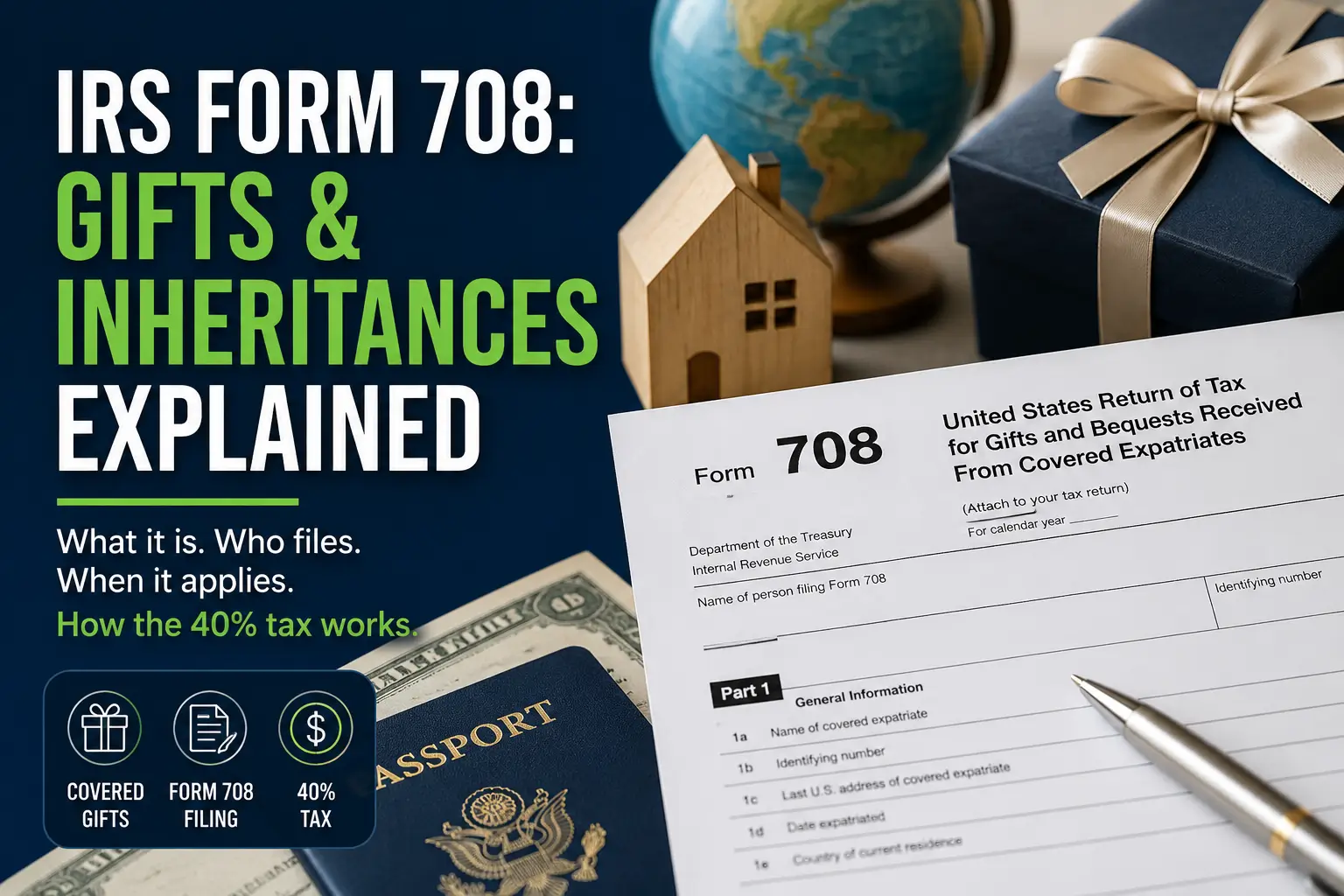
IRS Form 708 is the U.S. tax return that U.S. citizens, U.S. residents, and certain domestic trusts must file when they receive substantial gifts or inheritances from a “covered expatriate.”
The form reports these transfers and calculates any tax due at a rate of up to 40% on the amount exceeding available exclusions. While the exit tax gets more attention during renunciation, Form 708 often creates longer-lasting consequences for families.
What Is IRS Form 708?
IRS Form 708, officially the United States Return of Tax for Gifts and Bequests Received From Covered Expatriates, implements special rules under IRC Section 2801. It requires U.S. persons to report and potentially pay tax on certain gifts and inheritances received from individuals who renounced U.S. citizenship (or long-term residents who gave up their green cards) and are classified as covered expatriates.
The form ensures that assets transferred from a covered expatriate do not entirely escape U.S. transfer tax rules. The recipient, not the person who renounced, bears the primary reporting and payment responsibility. This creates a unique cross-border estate planning consideration that many families overlook until it is too late.
Form 708 is relatively new in practice (with final regulations and a draft form released in recent years), but it has significant implications for international families.
Who Is Required to File Form 708?
You generally need to file IRS Form 708 if you are:
- A U.S. citizen
- A U.S. resident (for tax purposes)
- A domestic trust
and you receive a covered gift or covered bequest from a covered expatriate.
The obligation falls on the recipient, not the covered expatriate. This means even if your parent, spouse, or other family member renounced years earlier, you could face filing requirements and potential tax when they transfer assets to you.
Domestic trusts that receive such transfers also have reporting duties. Foreign trusts have separate rules, including potential distributions that may trigger Form 708 obligations.
What Is a Covered Expatriate?
A covered expatriate is a former U.S. citizen or long-term green card holder who meets any one of three IRS tests at the time of expatriation:
- Net Worth Test — Worldwide net worth of $2 million or more.
- Tax Liability Test — Average annual net U.S. income tax liability exceeding the threshold
- Certification Test — Failure to certify five years of U.S. tax compliance on Form 8854.
Failing to properly certify tax compliance is one of the most common ways individuals become covered expatriates.
When Does Form 708 Apply?
Form 708 applies to covered gifts (lifetime transfers) and covered bequests (transfers at death) received on or after June 17, 2008, from a covered expatriate.
- Covered gifts include cash, property, or other assets transferred directly or indirectly during the covered expatriate’s lifetime.
- Covered bequests include inheritances received after the covered expatriate’s death.
- Certain distributions from foreign trusts attributable to covered gifts or bequests may also trigger reporting.
Common misconceptions include assuming small annual gifts are always exempt or that the rules only apply immediately after renunciation. In reality, Form 708 can apply many years later whenever a qualifying transfer occurs.
There is an annual exclusion amount (similar to the regular gift tax exclusion), and certain gifts (such as to a U.S. citizen spouse in some cases) may qualify for exceptions. Always review your specific situation with a professional.
How Much Is the Tax?
Form 708 imposes a 40% tax on covered gifts and bequests.
The calculation is straightforward:
- Identify the covered gift or bequest amount.
- Subtract the applicable annual exclusion for the year (adjusted annually for inflation).
- Apply the 40% tax rate to the excess.
Example: A covered expatriate gives $600,000 to a U.S. citizen in 2026. If the annual exclusion is $20,000, the taxable amount is $580,000. The Section 2801 tax is $232,000 (40% of $580,000).
Who pays the tax? Generally, the U.S. recipient pays it. However, the covered expatriate can voluntarily agree to pay on behalf of the recipient.
Important deadlines: Form 708 is due on the 15th day of the 18th month after receipt of the covered gift or bequest. A six-month extension for filing is available, but this extension does not extend the deadline for tax payment itself.
Late filing incurs penalties under Section 6651. Taxpayers should keep detailed records for Form 708 compliance.
Example 1: Lifetime Gift
John renounces U.S. citizenship without becoming tax compliant. Because he fails to certify five years of tax compliance on Form 8854, he becomes a covered expatriate.
Ten years later, he gives his daughter, who remains a U.S. citizen, $500,000.
His daughter files IRS Form 708 because she received a covered gift from a covered expatriate. She calculates the transfer tax after applying any available exclusions and exceptions. The remaining taxable amount is generally subject to the 40% tax under IRC Section 2801.
Example 2: Inheritance
A covered expatriate passes away and leaves a substantial estate (including foreign assets) to U.S. citizen children. The heirs must evaluate each bequest for Form 708 reporting and potential 40% tax liability.
Example 3: Successful Compliance
An expat becomes fully tax compliant, files five years of returns and six years of FBARs, certifies properly on Form 8854, and avoids covered expatriate status. Future gifts and bequests to U.S. family members generally do not trigger Form 708.
IRS Form 708 vs. Exit Tax
Many people researching renunciation focus almost entirely on the exit tax. That makes sense: the exit tax sounds immediate, expensive, and intimidating.
In practice, however, most Americans abroad do not owe exit tax because they do not meet the applicable wealth or average annual tax liability thresholds.
IRS Form 708 is different. It can affect U.S. family members years after the renunciation is complete.
| Exit Tax | IRS Form 708 |
|---|---|
| Paid by the expatriate | Paid by the U.S. recipient |
| Applies at the time of expatriation | Applies when covered gifts or covered bequests are received |
| Based largely on the expatriate’s assets at renunciation | Based on future gifts, bequests, and certain trust distributions |
| Most Americans abroad do not owe it | Can affect U.S. family members years later |
| Gets most of the attention | Often creates the bigger long-term planning issue |
From our experience, many clients spend months worrying about the exit tax, only to discover that they do not owe it.
The bigger issue is often covered expatriate status itself. Once someone becomes a covered expatriate, future gifts, inheritances, and certain trust distributions to U.S. persons can create Form 708 filing obligations and potential transfer tax exposure.
How Can You Avoid IRS Form 708?
The best planning starts before renouncing U.S. citizenship. IRS Form 708 applies because the transfer comes from a covered expatriate. Therefore, the most important planning step is to avoid covered expatriate status whenever possible.
For many Americans abroad, that means becoming tax compliant before renouncing.
Before expatriating, you should review:
- Whether you were required to file U.S. tax returns.
- Whether you were required to file FBARs.
- Whether you can certify five years of tax compliance on Form 8854.
- Whether you meet the net worth test.
- Whether you meet the average annual income tax liability test.
If you can certify five years of tax compliance and you do not meet the other covered expatriate tests, you can avoid covered expatriate status.
That means future gifts or inheritances to U.S. family members are not subject to Form 708 solely because you renounced U.S. citizenship.
Becoming Tax Compliant Before Renouncing
To avoid becoming a covered expatriate under the tax compliance test, you must be able to certify that you complied with your U.S. tax obligations for the five tax years before expatriation.
For most Americans abroad, this means:
- Filing five years of required U.S. tax returns.
- Filing six years of FBARs, if required.
- Filing your final U.S. tax return for the year of expatriation.
- Filing Form 8854 correctly.
This does not mean every person renouncing must file five years of returns. If you had no U.S. filing obligation, you do not need to create returns simply because you are renouncing.
But if you were required to file and did not, becoming compliant before renouncing can make a major difference. It can allow you to certify tax compliance, avoid covered expatriate status, and prevent future Form 708 complications for U.S. beneficiaries.
Why Form 708 Matters for Families
Form 708 is not just a technical tax form.
It affects how wealth passes between family members after expatriation.
This matters especially when:
- A parent renounces U.S. citizenship but has U.S. citizen children.
- A former U.S. citizen plans to leave assets to family in the United States.
- A covered expatriate owns property, investments, or cash intended for U.S. beneficiaries.
- A foreign trust or domestic trust is part of the estate plan.
- A family assumes that renunciation ends all U.S. tax issues forever.
Renunciation ends citizenship. It does not automatically remove every future U.S. tax consequence connected to covered expatriate status.
That is why families should review Form 708 before the renunciation is complete, not years later when a gift or inheritance is already being transferred.
Our Renunciation Package
For many Americans abroad, the safest path is to become compliant before renouncing.
Our Renunciation Package is designed to guide you through the tax side of the expatriation process, including the filings needed to certify tax compliance and reduce the risk of covered expatriate status.
The package includes:
- Five years of required U.S. tax returns.
- Six years of FBARs, if required.
- Guidance throughout the renunciation process.
Becoming compliant before renouncing can protect both you and your family. It can reduce exit tax concerns, help avoid covered expatriate status, and prevent unnecessary Form 708 issues for U.S. recipients of future gifts or inheritances.
For more information about the renunciation process itself, read our Renouncing U.S. Citizenship FAQ.
If you are worried about the exit tax, read our detailed U.S. Exit Tax guide to understand when it applies and why most Americans abroad do not end up owing it.


