

This guide walks you through filling out Form DS-4079, the questionnaire you must complete to officially give up your U.S. citizenship. Think of it as an official questionnaire that proves you really want to do this, and that nobody forced you. Read each section carefully. Some parts you do at home, some parts must be done at the embassy.
IMPORTANT: Check with your embassy first
Every embassy has its own rules. Some let you fill most of the form at home. Others ask you to complete the entire form in person during your appointment. Always confirm the requirements with your specific embassy before writing anything on the form.
What Is Form DS-4079?
Form DS-4079 is a questionnaire used by the U.S. Department of State when someone applies for a Certificate of Loss of Nationality (CLN). The form helps the embassy understand your background and confirm that you are voluntarily giving up your U.S. citizenship.
For most of our clients, the basis for obtaining a CLN is renunciation under INA 349(a)(5). In that case, you generally only need to complete:
- Part I-A (Background Information)
- Part I-B (Oath of Renunciation)
- Part II (completed at the embassy)
The remaining sections relate to people claiming they already lost citizenship through a past expatriating act and are usually not relevant to renunciation cases.
New to the renunciation process? Before completing Form DS-4079, you may find it helpful to review our Renouncing U.S. Citizenship FAQ, which covers embassy appointments, processing times, tax compliance, exit tax rules, and what happens after you receive your Certificate of Loss of Nationality.
Part I-A — Background Information
About you. Everyone must complete this part
This is the “who are you?” section. Think of it as filling in your profile. Everyone applying for a Certificate of Loss of Nationality must complete all 8 items here.
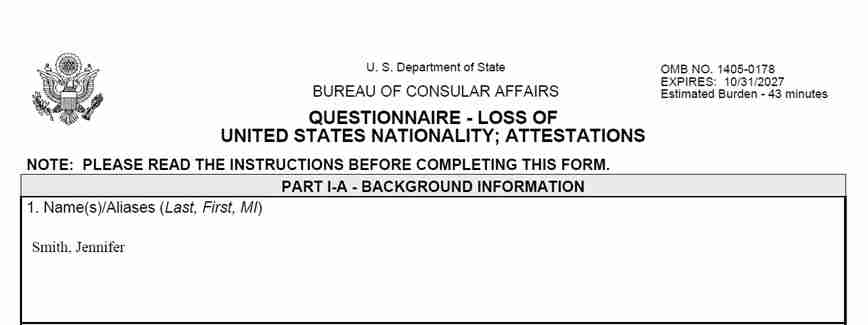
Item 1
Your full name and any other names you’ve used
Write your last name first, then your first name, then your middle initial. Include any nicknames, maiden names, or former names you’ve ever officially used.
Example: Smith, Jennifer
Item 2
Your mailing address, email, and phone number
Use your current physical address — where you actually live and receive mail. Do not use a P.O. box. Include your email and a working phone number so the embassy can reach you.
Example:123 Main Street, Apt 4,
Toronto 1000, Canada
+ 123456789
myemail@email.com

Item 3
Date of birth
Always write the month first, then the day, then the 4-digit year.
Example: 03-15-1985 means March 15, 1985

Item 4
Place of birth
Write the city, the state or region, and the country where you were born. Use the name the country had at the
time you were born if it has since changed.
Example: Chicago, Illinois, United States

Item 5
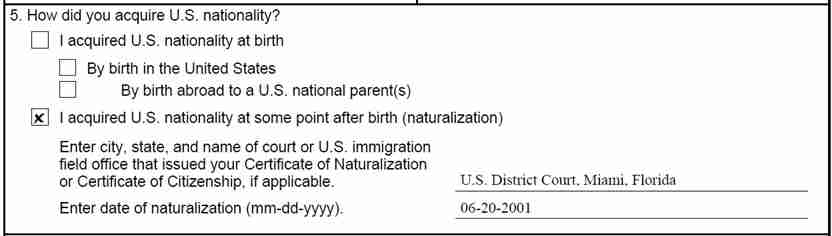
How did you become a U.S. citizen?
Tick the box that matches you. Most people are either born in the U.S., born abroad to a U.S. parent, or naturalized (went through a ceremony and got a certificate). If you were naturalized, also fill in the name of the court or immigration office and the date.
Example: U.S. District Court, Miami, Florida — Date: 06-20-2001
Item 6
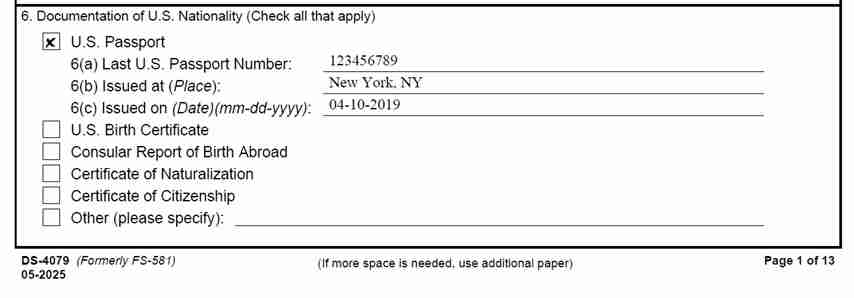
What documents prove your U.S. citizenship?
Tick every box that applies. Most people tick U.S. Passport. If you have a passport, also fill in the passport number (6a), where it was issued (6b), and the date it was issued (6c).
Example: Passport number 123456789, issued at New York, NY, on 04-10-2019
Item 7
Your connections to the United States
7a: Do you live in the U.S. now, or do you keep a place there? If yes, list the address and dates.
7b: Do you use any rights or benefits that require U.S. citizenship? The form lists examples: unexpired U.S. passport, voting in U.S. elections, Medicare, disability or retirement benefits, a U.S. driver’s license, or immigration benefits. Tick yes or no for each one honestly.
IMPORTANT: If you’re still using a U.S. passport to travel, tick yes.
Item 8
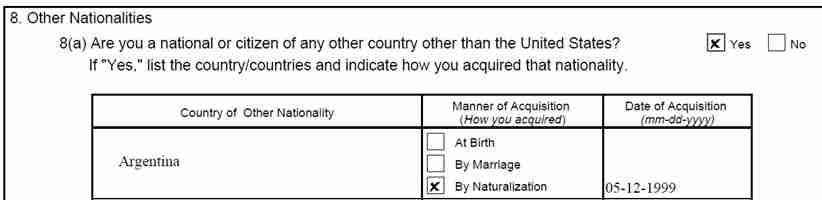
Do you have citizenship in any other country?
Tick yes or no. If yes, list each country and explain how you got that citizenship (at birth, by marriage, or by naturalization) and when.
Example: Argentina — by naturalization — 05-12-2022
Important: Do not assume you can renounce U.S. citizenship without first obtaining another nationality. Consular officers generally will not approve a renunciation that would leave you stateless. If you do not currently hold another citizenship, contact your embassy before proceeding.
Part I-B — Oath of renunciation
Your reasons for giving up citizenship. Complete at home
This section is for people who are choosing to formally renounce their U.S. citizenship by taking an oath in front of a consular officer. Complete items 9–12.
Item 9
Are you applying based on taking the oath of renunciation?
Tick Yes. This confirms you are going to the embassy to formally renounce, not because of some past act like joining a foreign military.

Item 10
Which embassy or consulate will you go to?
Write the full name and country of the embassy or consulate where you will have your in-person interview and take the oath. Check the embassy’s website for the exact official name.
Example: U.S. Embassy Sofia, Bulgaria

Item 11
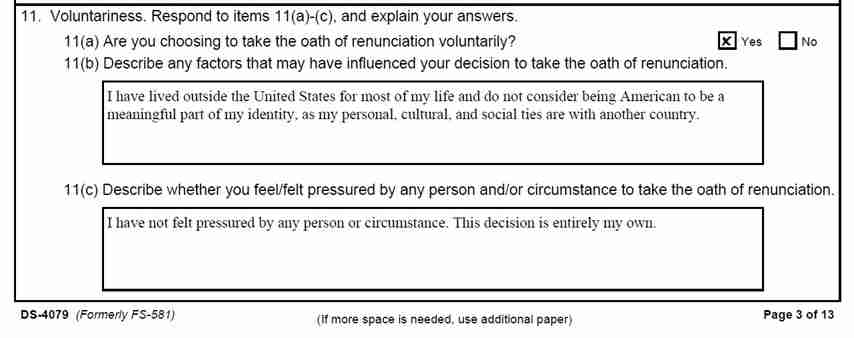
Is this your own choice? (Voluntariness)
11a: Tick Yes, you are choosing this freely.
11b: Describe what made you want to do this. Be honest and personal. Write a few sentences about your life situation, your ties to another country, your reasons. There is no wrong answer here as long as it is true.
11c: Confirm that nobody pressured you.
Example: “I have not felt pressured by any person or circumstance. This decision is entirely my own. I have lived outside the United States for most of my life and do not consider being American to be a meaningful part of my identity, as my personal, cultural, and social ties are with another country.”
Item 12
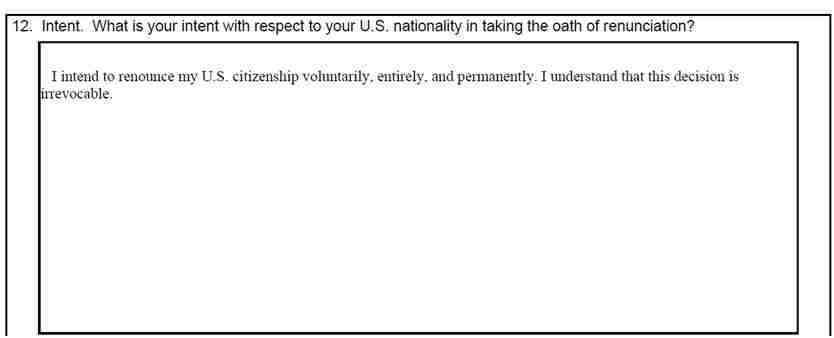
What do you intend to do with your U.S. nationality?
Write clearly that you intend to give it up permanently. This is the heart of the whole form. The officer needs to see that you understand what you are doing and that you mean it.
Example: “I intend to renounce my U.S. citizenship voluntarily, entirely, and permanently. I understand that this decision is irrevocable.”
Parts I-C through I-F — Relinquishment Cases Only
Skip these — they do not apply to renunciants
Part II — Attestations (oaths and signatures)
Do NOT fill this in at home — embassy only
Part II is the formal legal part. It contains statements you swear to under oath, and your actual renunciation. The law requires that you sign this only while physically in front of a U.S. consular officer. Do not sign this at home.
Part II-A — Statement of understanding
A list of consequences you confirm you understand: you will become a foreigner in the U.S., you may still owe U.S. taxes, you cannot pass citizenship to future children born abroad, and this is permanent and cannot be undone. The officer will go through this with you.
Part II-B — Statement of voluntariness and intent
You confirm one more time that you did this freely and with the intent to give up your U.S. nationality.
Part II-C — The actual oath of renunciation
This is the formal ceremony. You swear or affirm that you are giving up your U.S. nationality entirely and forever, of your own free will. The consular officer witnesses this and signs too. Once this is done, the process is complete on your end.
Part II-D — Final attestation of accuracy
You confirm that everything you wrote on the form is true and complete. Also signed at the embassy.
Final tips before you submit
A quick checklist to avoid common mistakes
• Do not sign Part II at home – only at the embassy, in front of the officer.
• Always use month-day-year format (mm-dd-yyyy) for all dates.
• Write clearly and in pen if submitting a paper copy.
• Attach extra pages if a text box is not big enough – write the item number at the top.
• Bring originals or certified copies of every document – no regular photocopies.
• Check your specific embassy’s website for any extra requirements – appointment systems, fees, and accepted documents vary by location.
Looking for more information about the renunciation process? Visit our Renouncing U.S. Citizenship FAQ for answers to the most common questions we receive from clients.
This guide is for informational purposes only and does not constitute legal advice. Always verify requirements directly with the U.S. embassy or consulate handling your case


