

Editor’s Note (July 3, 2026): This article was published following the removal of the IRS’s Delinquent FBAR Submission Procedures webpage on July 1, 2026. At the time of publication, the IRS has not issued a formal announcement explaining the change. This analysis is based on the removal of the official guidance, the current Internal Revenue Manual, the underlying FBAR penalty statute, and commentary from experienced U.S. international tax professionals. We will update this article if the IRS releases additional guidance or clarification.
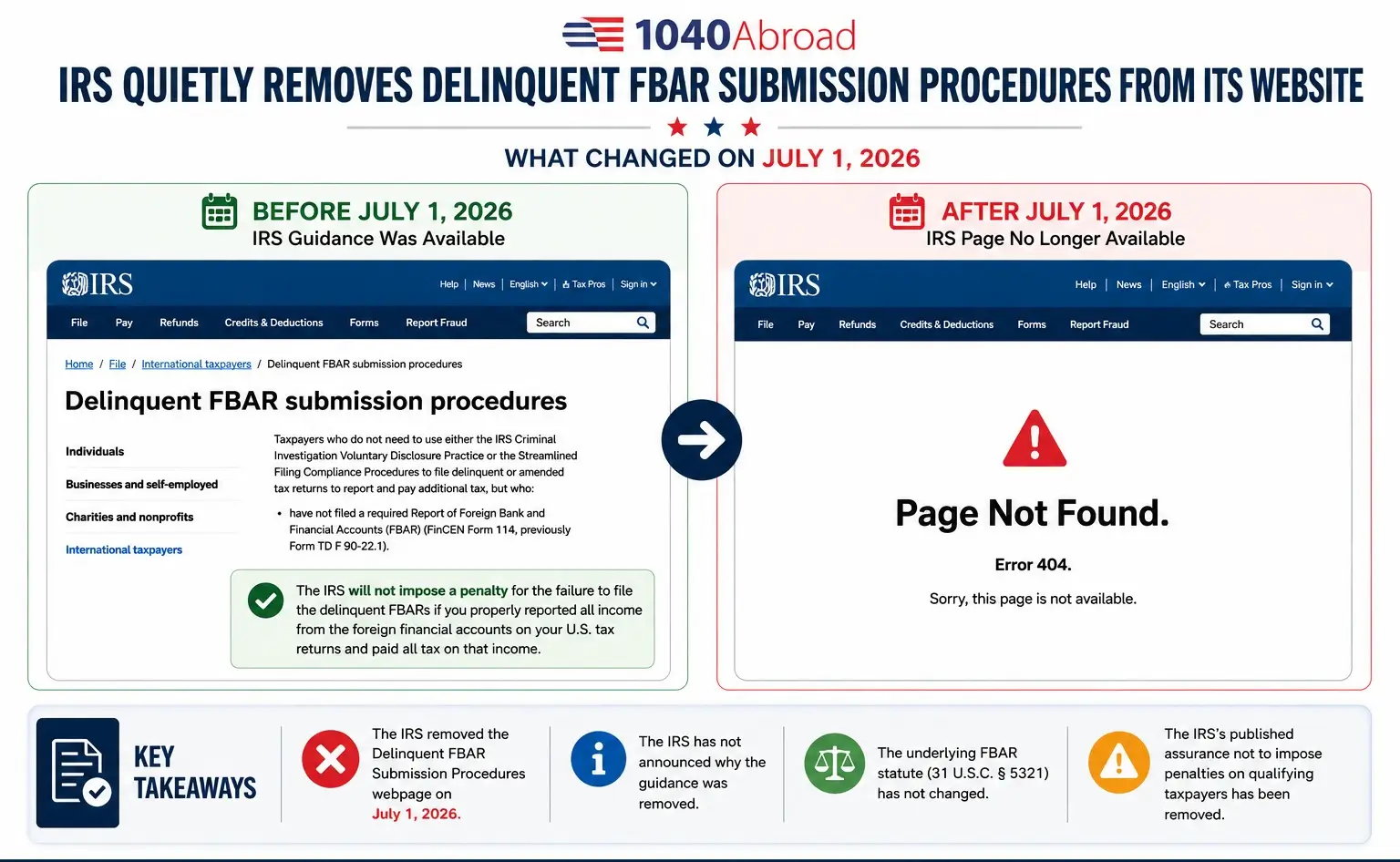
The IRS has removed its Delinquent FBAR Submission Procedures from its website, eliminating a longstanding administrative process that assured many taxpayers they would not be penalized for filing late Foreign Bank Account Reports (FBARs) when all related income had been properly reported and taxes paid.
The webpage disappeared on July 1, 2026, without any public announcement or explanation from the IRS.
While the removal does not change the underlying FBAR law or automatically mean taxpayers will face penalties, it does eliminate one of the clearest pieces of administrative guidance available to Americans who simply failed to file an FBAR despite otherwise remaining tax compliant.
What Were the Delinquent FBAR Submission Procedures?
The Delinquent FBAR Submission Procedures were intended for taxpayers whose only compliance issue was failing to file an FBAR.
To qualify, taxpayers generally needed to:
- Have properly reported all income generated from their foreign financial accounts on their U.S. tax returns.
- Have paid all tax due.
- Not be under IRS civil examination or criminal investigation.
- Not have already been contacted by the IRS regarding the missing FBARs.
Importantly, these procedures were not intended for taxpayers who also needed to amend tax returns, report previously omitted income, or enter one of the IRS’s broader voluntary disclosure or Streamlined Filing Compliance Procedures.
The IRS’s Penalty Promise Is Gone
The most significant feature of the former procedures was the IRS’s explicit commitment regarding penalties.
The guidance stated that the IRS would not impose an FBAR penalty if a taxpayer:
- Properly reported all income from the foreign accounts,
- Paid all tax due, and
- Submitted the delinquent FBARs before being contacted by the IRS.
That language has now disappeared with the removal of the webpage.
Although the IRS has not announced a change in policy, taxpayers can no longer point to this published guidance as an administrative assurance that qualifying late FBAR filings will be penalty-free.
Does This Mean Automatic Penalties?
No. The removal of the Delinquent FBAR Submission Procedures does not automatically trigger penalties for taxpayers who file late FBARs.
The underlying law remains unchanged.
Under 31 U.S.C. § 5321, the Secretary of the Treasury may impose civil FBAR penalties. The statute authorizes penalties but does not require them in every case, leaving the IRS with discretion when determining whether a penalty is appropriate.
The IRS Internal Revenue Manual also continues to recognize examiner discretion. Depending on the circumstances, an examiner may determine that a warning letter—or no penalty at all—is appropriate. The stated objective of the FBAR compliance program remains encouraging voluntary compliance rather than penalizing every late filer.
Taxpayers Can Still Explain Why the FBAR Is Late
One aspect of the filing process remains unchanged.
When submitting a late FBAR through the BSA E-Filing System, taxpayers are still asked to explain why the filing is late by selecting a reason from a drop-down menu.
Examples include:
- Lack of awareness of the filing requirement.
- Forgetting to file.
- Filing under one of the IRS’s voluntary compliance programs, such as the Streamlined Filing Compliance Procedures.
Providing an accurate explanation remains an important part of submitting a delinquent FBAR, even though the IRS’s separate Delinquent FBAR Submission Procedures page has been removed.
Why This Change Matters
The removal of the webpage creates uncertainty rather than changing the law itself.
Previously, taxpayers who met the stated eligibility requirements could rely on published IRS guidance confirming they would not face penalties simply for filing late FBARs.
Now, taxpayers must instead rely on the IRS’s statutory discretion and existing administrative guidance.
That distinction may seem subtle, but it is significant. A published promise of penalty relief has been replaced by discretionary enforcement.
Could This Signal Broader Changes?
It is too early to know. During discussions among international tax practitioners following the webpage’s removal, concerns were raised that this could reflect a broader shift in how the IRS approaches longstanding penalty-relief initiatives.
Practitioners noted that the IRS has previously revised language surrounding other international compliance procedures and pointed to ongoing disputes involving Forms 3520 and other international information returns, where taxpayers have challenged penalty assessments despite submitting detailed reasonable cause statements.
At this stage, however, the IRS has not announced any changes to the Streamlined Filing Compliance Procedures or other voluntary disclosure options.
What Should Taxpayers Do?
If you recently discovered that you failed to file an FBAR, this development should not cause panic—but it should encourage prompt action.
The appropriate solution depends on your individual circumstances.
Some taxpayers may only need to file delinquent FBARs with an explanation through the BSA E-Filing System. Others may require a more comprehensive voluntary compliance strategy if additional international reporting obligations or unreported income are involved.
Because the IRS’s explicit administrative assurance has now been removed, obtaining professional advice before filing may be more important than ever.
What This Means for Taxpayers
The IRS quietly removed the Delinquent FBAR Submission Procedures from its website on July 1, 2026, eliminating a longstanding administrative process that expressly stated qualifying taxpayers would not be penalized for filing late FBARs after properly reporting all related income and paying all tax due.
The removal does not change the law, nor does it make FBAR penalties automatic.
However, it does remove an important piece of published IRS guidance that taxpayers and practitioners have relied upon for years.
Until the IRS provides further clarification, taxpayers with delinquent FBARs should carefully evaluate their compliance options before filing.
Need help with a late FBAR?
Every situation is different. If you’ve discovered that you failed to file an FBAR, our international tax professionals can help you determine the appropriate filing approach based on your specific facts. Visit our Delinquent FBAR Submission Service page to learn more about the process and whether this option may be appropriate for your situation.


