

Most U.S. expats do not receive a W-2 because they work for a foreign employer. That is completely normal. Even without a W-2 form, taxpayers living abroad must still file your tax return, and comply with U.S. taxes each year. Taxpayers must ensure their tax filings are complete and accurate, even when filing without a W-2, to avoid errors, penalties, or delays.
Accurate income reporting is important for determining eligibility for certain tax credits and deductions.
The key is understanding how to file taxes without a W-2 form by using your own records, foreign tax statement, and other documentation that shows your wages.
What Is a W-2 Form?
A W-2 form, also called a wage and tax statement, is a tax statement issued by a U.S. employer. The form W-2 reports your annual wage, and taxes withheld to both the employee and the IRS.
A typical form W-2 includes:
- Total wage and earnings
- Federal and state taxes withheld
- Social Security withheld
- Retirement contributions
- The employer name and address
- Your social security number
The information on your W-2 is used to calculate whether you are owed a refund or need to pay additional taxes.
Employers must issue the W-2 form by the end of January each year. For the 2026 tax season, employers are required to provide W-2 forms by February 2, 2026.
The IRS receives a copy of every W-2 filed by employers. This means the IRS already has your reported wage and income information before you file your tax return.
However, this system only applies when the employer operates under U.S. payroll rules.
Why U.S. Expats Usually Do Not Receive a W-2
Most Americans abroad work for a foreign company. In that situation, the foreign employer is not required to issue a W-2 form or send a wage and tax statement to the IRS. While many employers in the U.S. offer electronic W-2s for faster access, foreign employers typically do not provide this option.
Instead, the foreign payer follows local employment laws and may provide a local tax statement or salary certificate.
Because the foreign payer does not submit a form W-2, the IRS never receives an official tax statement for your foreign wage.
Can I File Taxes Without a W-2?
Yes, you can file taxes without a W-2 form by reporting your foreign income directly on your tax return.
You do not need a form W-2 to file a U.S. tax return if your employer is foreign. Instead of relying on a wage and tax statement, you simply gather your own records to determine your total wages.
Millions of Americans abroad file their tax return without a W-2 every year.
How To File Taxes Without a W-2
When you file taxes without a W-2, the process is straightforward. You just report income using your own records rather than a form W-2.
Step 1: Gather Your Income Records
Start by collecting documentation that shows your total income for the year.
Common records include:
- Final pay stub
- Foreign tax statement
- Annual salary summary
- Employment contract
- Bank statements
- Bank records
These documents allow you to estimate your total wage and confirm your earnings before you file your taxes.
Step 2: Convert Foreign Income to U.S. Dollars
Foreign income must be converted into U.S. dollars when preparing your tax return.
Use a consistent exchange rate for the entire tax year when you report your wage.
This ensures the income reported on your tax return is correct.
Step 3: Report Foreign Wages on Form 1040
Even without a W-2, you still use the standard form.
Foreign wage is entered on:
Form 1040 – Line 1 (Wages, salaries, tips)
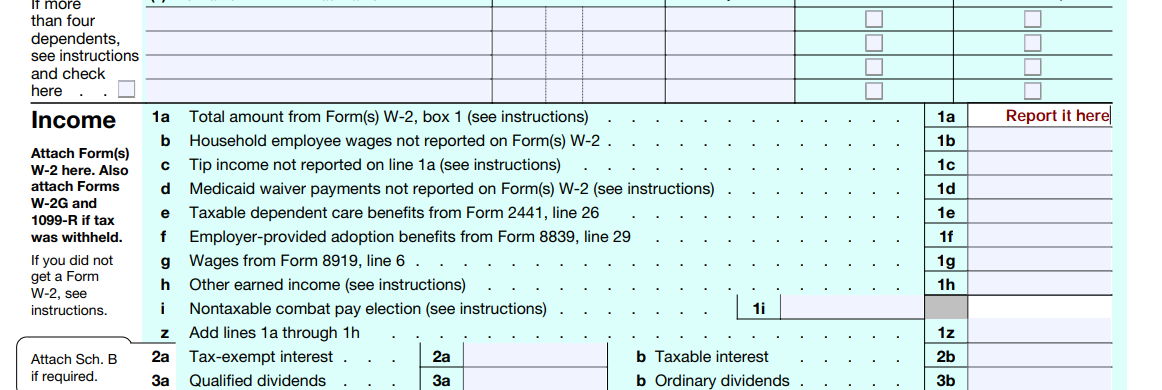
You simply enter the total income you earned abroad. You do not attach a W-2 form if your employer did not issue one.
This allows you to file your tax return normally.
Step 4: Report Foreign Taxes Paid
If your foreign employer withheld local taxes, those amounts may also appear on a local tax statement.
Those foreign taxes withheld may qualify for tax relief mechanisms such as:
- Foreign tax credit form
- Foreign earned income exclusion form
These forms help reduce double taxes on the same income.
Step 5: Keep Documentation for Your Records
Even though the IRS does not require attaching foreign records, you should keep documentation showing your income.
Maintain copies of:
- Foreign tax statement
- Final pay stub
- Bank records
- Employment contract
- Local tax filings
- Retirement statements if applicable
Filing as a Self-Employed Individual
If you are self-employed or work as an independent contractor, you will not receive a W-2 form from an employer. Instead, your income is typically reported on a 1099-NEC form (Non-Employee Compensation) from each client or payer. However, even if you are missing a 1099-NEC or never receive one, you are still required to file your tax return and report all your business income.
Do Expats Need Form 4852?
Form 4852 is a substitute form used when a U.S. employer fails to provide a form W-2. Form 4852 can serve as a substitute for Form W-2, Form W-2c, and Form 1099-R when the original tax statement is unavailable.
However, most expats do not need form 4852 substitute because there is no missing W-2. A foreign employer simply does not issue the form.
You would only use form 4852 substitute if:
- A U.S. employer failed to send a form W-2
- The payer issued an incorrect wage and tax statement
- You had U.S. employment with a missing form
In those situations, form 4852 allows you to estimate the wage, and taxes withheld using records such as a pay stub or payroll summary.

What If You Are Missing a W-2 From a U.S. Employer?
This situation is different from expats working abroad.
If you expected a W-2 form from a U.S. employer but never received it, start by contacting the payer.
Steps include:
- Contact your employer
- Request a replacement wage and tax statement
- Confirm your mailing address
- Check whether an electronic copy is available in your payroll account
If you are still unable to obtain the form W-2 by mid February, you can contact the IRS for assistance.
If the missing W-2 remains unresolved, you may need to file using form 4852 substitute.
Using IRS Transcripts Instead of a W-2
If you had U.S. employment, you may also request a wage and income transcript from the IRS.
The income transcript shows wage and tax statement data submitted by a payer.
However, foreign employment rarely appears on an income transcript because the foreign employer never submitted a form W-2.
This is why expats typically rely on their own records.
Common Filing Mistakes Without a W-2
When you file taxes without a W-2 form, it is important to double-check your numbers.
Common errors include:
- Reporting an incorrect income amount
- Forgetting to report income
- Using the wrong exchange date
- Failing to verify totals
- Entering the wrong wage
Because the IRS receives a copy of every W-2 your employer files, your tax return must match what the employer reported. If your numbers do not match, it could trigger IRS catch system triggers follow-up, review, or processing delays.
Need Help Filing Without a W-2? Contact Us
Filing your U.S. taxes as an expat — especially without a W-2 — can feel overwhelming, but it doesn’t have to be. We’re experts in U.S. expat tax filing, and we’re here to help.
Whether you need help understanding how to report your total wages, navigate the IRS website, or organize your tax information, we’ve got your back. We even offer free tax advice to all U.S. expats.
Contact us today and let us help you file with confidence this tax season — no W-2 required.


