

Form 1040-NR is required when a nonresident alien has U.S.-source income that triggers a federal filing requirement. It explains who must file, who cannot, how to file, where to file, how much it costs, and how residency status is determined.
Form 1040-NR is the primary tax form used by nonresident aliens for filing a U.S. tax return.
What Is Form 1040-NR?
Form 1040-NR is the U.S. income tax return used by a nonresident alien to report U.S. sourced income to the Internal Revenue Service.
This tax form is required when a nonresident alien has source income from the United States, such as wages, rental income, capital gains, taxable scholarship, fellowship grant, farm income, or FDAP income.
The form is the official alien income tax return used to calculate tax liability, determine taxes owed, or claim a tax refund.
Nonresident aliens are taxed only on income from U.S. sources and are not taxed on foreign income earned outside the United States.
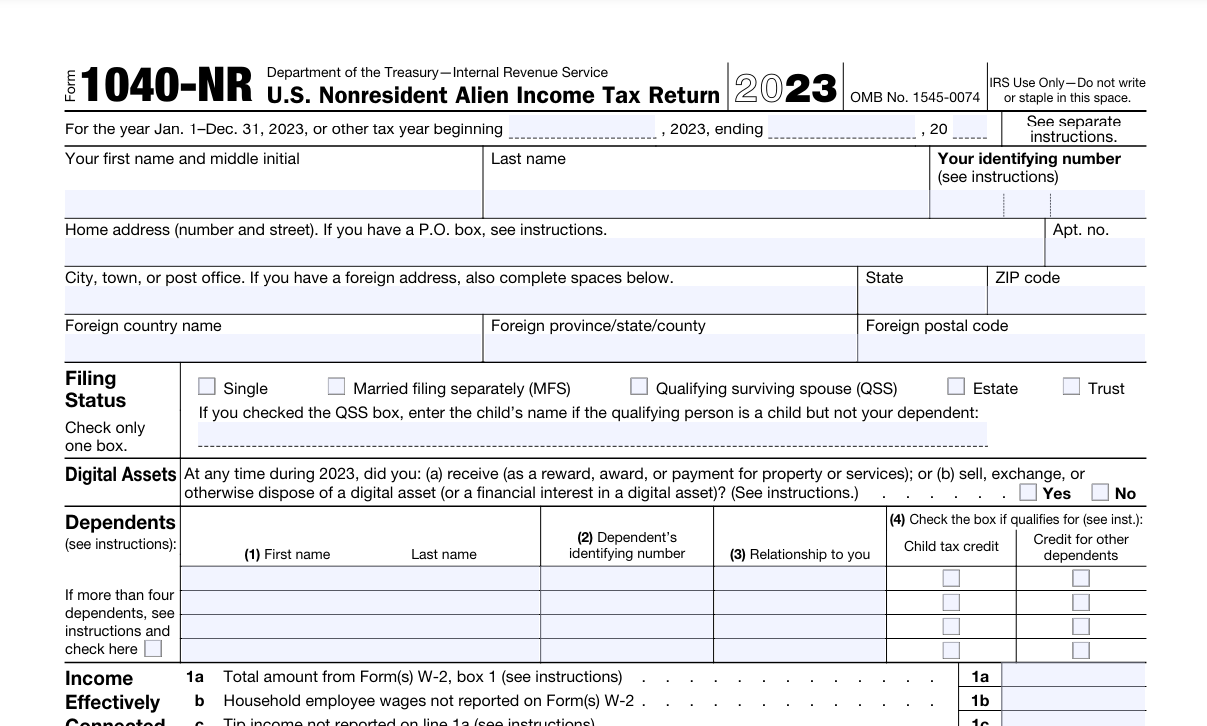
The official IRS Form 1040-NR can be downloaded directly from the IRS website and should be used when preparing a nonresident alien tax return.
Who Files 1040NR?
A nonresident alien files Form 1040-NR only if they owe U.S. tax or want a refund of U.S. tax.
A nonresident alien is an individual who is not a U.S. citizen and who has not passed the green card test or the substantial presence test.
You must file Form 1040NR if you are a nonresident alien and earned U.S. source income during the tax year or were engaged in a trade or business in the United States, including effectively connected income.
Common filers include international students, researchers, scholars, crew members on a foreign vessel, and other non resident aliens, including students on F-1 or J-1 visas.
What Income Requires Filing Form 1040-NR?
A nonresident alien must report income on form 1040NR if they receive:
- US sourced income from wages or salaries
- FDAP income reported on Schedule NEC:
- Rental income from U.S. property
- Capital gains tied to U.S. assets
- Qualified dividends scholarship or taxable scholarship
- Fellowship grant payments
- Farm income or income from business activities in the U.S.
This income is subject to income tax withholding or direct payment of income tax under the U.S. tax system.
Income that is effectively connected with a U.S. trade or business is taxed differently than passive income and may allow deductions for business expenses.
What’s the Difference Between Form 1040 and Form 1040-NR?
Form 1040 is used by U.S. citizens and resident aliens to report worldwide income.
Form 1040NR is used by nonresident aliens to report only U.S. sourced income.
Key differences:
- Resident aliens report worldwide income
- Nonresident aliens report only U.S. source income
- Nonresident aliens cannot claim the standard deduction and may only claim limited itemized deductions.
- Nonresident aliens do not get the standard deduction and can deduct far fewer expenses than resident aliens.
- Tax treaty benefits may apply only on form 1040NR
| Criteria | Nonresident Alien | Resident Alien |
|---|---|---|
| Residency Qualifications | Neither a U.S. citizen nor a national, and does not meet the green card or substantial presence tests. | Either holds a green card or meets the substantial presence test (31 days in the current year and 183 days over a 3-year period). |
| Taxation | Taxed only on U.S. sourced income. | Taxed on worldwide income, similar to U.S. citizens. |
| Tax Forms | Must file Form 1040NR. | Files Form 1040, the same as U.S. citizens. |
| Eligibility for Deductions/Credits | Limited eligibility for tax deductions and credits. | Same eligibility for deductions and credits as U.S. citizens. |
The two forms apply different tax rules, even though some tax rates may be the same rates. Choosing the wrong tax form can result in incorrect reporting, missed deductions, or penalties, which is why understanding the differences between Form 1040 and Form 1040-NR is critical.
How Do I Know If I Am a Resident or Nonresident Alien?
Your resident alien status is determined by:
1. The Green Card Test
If you held a green card at any time during the year, you are a resident alien. Permanent residents cannot file form 1040NR.
2. The Substantial Presence Test
If you meet the substantial presence test, you are a resident alien for tax purposes.
If you fail both tests, you are a nonresident alien and must use form 1040NR if filing requirements apply.
Certain exempt individuals, including some international students, are excluded from this test.
If you are unsure how residency status is determined, this guide explains the key differences between a nonresident alien and a resident alien and how those classifications affect U.S. tax filing obligation
Can a Green Card Holder File 1040-NR?
No. A green card holder is a resident alien and must file Form 1040, not form 1040NR. Filing form 1040NR while holding a green card violates U.S. tax laws and can create potential penalties.
How Much Does It Cost to File Form 1040-NR?
At 1040 Abroad, we prepare Form 1040-NR for a flat fee of $500.
This includes:
- Full income tax return preparation
- Review of tax treaty positions
- Proper reporting of source income
- Compliance with nonresident alien tax obligations
There are no hidden fees during tax season.
How to File Form 1040-NR
You can file form 1040NR in one of three ways:
- E-filing through approved providers
- Mailing a paper IRS form
- Filing through a professional service
Not all software supports e filing for nonresident alien filing form requirements. To file Form 1040-NR, a nonresident alien must include a valid Taxpayer Identification Number, which is usually a Social Security Number or an Individual Taxpayer Identification Number.
The due date for filing Form 1040NR is generally April 15, similar to Form 1040.
Where to File Form 1040-NR
Where you file form depends on whether you include payment.
- Without payment: IRS Austin Service Center
Department of the Treasury
Internal Revenue Service
Austin, TX 73301-0215
USA - With payment:
Internal Revenue Service
P.O. Box 1303
Charlotte, NC 28201-1303
USA
The filing deadline for Form 1040-NR is generally April 15 of the following year if the nonresident alien had wages subject to U.S. income tax withholding.
How to Amend Form 1040-NR
If a nonresident alien makes a mistake on Form 1040-NR, the return can be corrected by filing Form 1040-X.
Common reasons include:
- Claiming missed tax treaty benefits
- Correcting income
- Adjusting tax credits
- Updating itemized deductions
Amended returns may change your tax liability or create a tax refund.
Can I Get an Extension to file form 1040NR?
Yes, nonresident aliens may request an additional extension to file Form 1040-NR by submitting Form 4868 by the original due date.
An extension delays the due date to file, but not the obligation to pay taxes.
Can Nonresident Aliens Claim Deductions or Credits?
Yes, but with limits.
A nonresident alien may:
- Claim deductions such as charitable contributions
- Deduct certain business expenses
- Use limited tax credits
- Elect to treat rental income as effectively connected
The standard deduction is generally not allowed, except in specific treaty cases.
How Do Tax Treaties Affect Form 1040-NR?
A tax treaty may:
- Reduce or eliminate U.S. income tax
- Prevent double taxation
- Allow special treaty benefits
Nonresident aliens may claim treaty benefits to reduce U.S. tax on U.S. sourced income, but they must file Form 1040NR to do so.
Treaty positions must be reported on form 1040NR, and eligibility depends on source income and residency in another country.


