

Form 8854 is the IRS form required when you give up U.S. citizenship or end long-term residency as a green card holder. It certifies that you met your federal tax obligations for the previous five years, determines whether you are a covered expatriate, and—only if you are a covered expatriate—calculates any exit tax based on the fair market value of your assets. Filing Form 8854 correctly is essential because failing to file can trigger severe penalties, automatic covered expatriate status, and ongoing U.S. tax obligations.
This guide explains who must file Form 8854, how to complete it step-by-step, and how to avoid costly mistakes during the expatriation process.
Note: A long-term resident, for Form 8854 purposes, is an individual who has held a green card in at least 8 of the last 15 tax years before the year of expatriation.
Who Must File Form 8854
You must file Form 8854 if you are:
- A U.S. citizen who gives up U.S. citizenship.
- A long-term resident or lawful permanent resident (held a green card for 8 of the last 15 years) who ends lawful permanent resident status.
- A person who loses citizenship through voluntary relinquishment, State Department approval, or notification to a diplomatic or consular officer abroad.
Both an initial filing and, in some cases, an annual expatriation statement are required.
If Form 8854 is not properly filed, the IRS treats you as a covered expatriate, and you may be subject to the expatriation tax.
Important: Returns related to expatriation cannot be filed jointly because immigration status changes are individual.
What Is the Purpose of Form 8854?
Form 8854 serves four essential purposes:
- To notify the IRS that you have expatriated or terminated long-term residency.
- To certify five years of full U.S. federal tax compliance before the year of expatriation.
- To determine whether you are a covered expatriate under U.S. tax law.
- To calculate the exit tax, but only if you are a covered expatriate, including deemed sale rules and taxation of deferred compensation under IRC §§877 and 877A.
For a full explanation of how the exit tax works, see our detailed guide: Exit Tax Explained: A U.S. Expat’s Guide to Expatriation Tax.
For former U.S. citizens, filing Form 8854 is required to stop being treated as a U.S. person for income tax purposes. Without it, the IRS continues to treat you as taxable on your worldwide income and may impose penalties.

Who is considered a covered expatriate in 2025?
A person is a covered expatriate in 2025 if any of the following apply at the time of expatriation:
1. Net Income Tax Liability Test: Your average annual net income tax liability for the five tax years before expatriation exceeds the 2025 threshold of $200,000.
2. Net Worth Test: Your net worth is $2 million or more on the day before your expatriation date. This amount is not indexed for inflation.
3. Five-Year Tax Compliance Test: You cannot certify, on Form 8854, that you met all U.S. federal tax obligations for the five years before expatriation.
Five-year Tax Compliance Rule: it requires U.S. citizens and long-term residents who expatriate to certify that they have been compliant with their U.S. tax obligations for the five years prior to their expatriation.
If you have delinquent income tax returns and need to get compliant before filing Form 8854, our Renunciation Package provides a complete solution. For a flat fee of $2,600, we handle your back filings, ensure full tax compliance, and streamline every step of the expatriation process—saving you time, uncertainty, and costly mistakes.
When to file Form 8854?
You should file your initial Form 8854 alongside your income tax return for the year that includes the date of your expatriation. This should be done by the due date of your tax return, including any extensions.
If you’re attaching Form 8854 to Form 1040, and 1040-NR, ensure it’s filed within this timeframe. Additionally, send a copy of Form 8854, marked as “Copy,” to the designated address.
Where to file?
To file your Form 8854, you should send it to the following address:
Internal Revenue Service
3651 S IH35
MS 4301AUSC
Austin, TX 78741
How to File Form 8854?
Here’s a guide on how to file Form 8854, incorporating the specific instructions provided by the IRS:
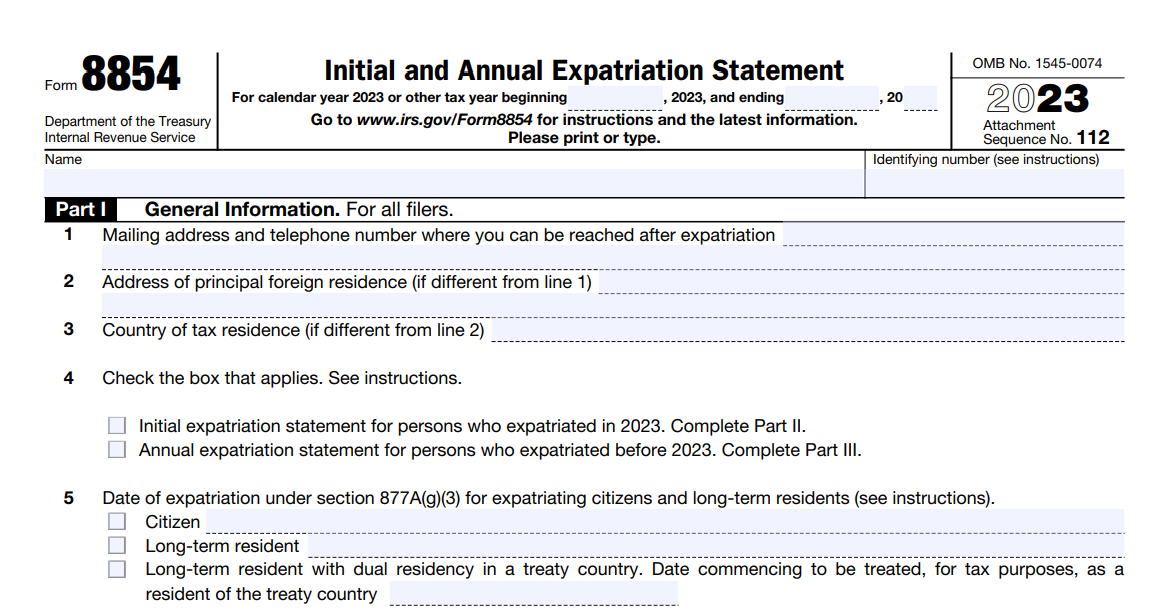
- Part I – General Information: This section gathers basic information and must be completed by all filers, addressing aspects from your address to your expatriation details:
-
- Identifying Number: Use your U.S. social security number as your identifying number. If you don’t have one, attach a statement explaining why.
- Address: If using a P.O. box due to no street delivery, include this instead of your street address.
- Residency for Tax Purposes: Specify the country where you’re considered a resident for tax purposes, which might differ from where your principal residence is located.
- Expatriation Information: Indicate whether your expatriation occurred in the filing year or before, and provide your expatriation date, aligning with the day before your expatriation for deemed sale calculations.

-
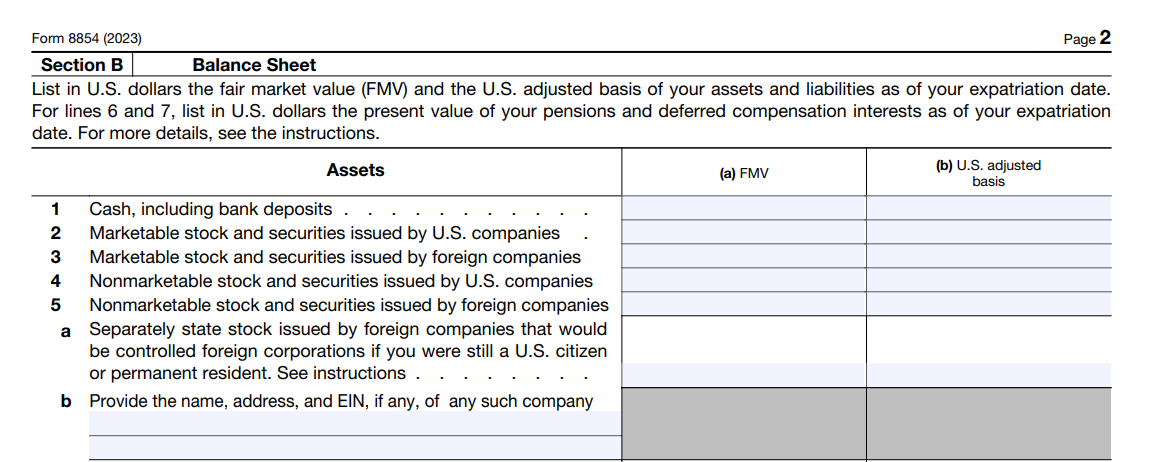
- Financial Information: Utilize the balance sheet section to outline your net worth, listing all assets and liabilities at fair market value on the day before your expatriation date. This includes property basis, foreign assets, and considerations for dual citizens.
- Tax Compliance: Confirm compliance with your tax obligations for the 5 years preceding your expatriation, covering all required filings and payments, crucial for avoiding complications with expatriation rules.
- Property and Deferred Compensation: Disclose information about any property owned and deferred compensation items, adhering to the valuation principles for property and understanding the implications for foreign country assets and foreign pensions.
- Filing and Submission: Attach your completed Form 8854 to your income tax return if you are required to file one for the year of your expatriation. If not filing a return, send Form 8854 directly to the IRS at the address provided for those undergoing the expatriation process.
- Tax Deferral Agreement: If electing to defer payment of tax due, follow the instructions in Part II, Section D, Line 5, for submitting your tax deferral agreement request, ensuring tax compliance and addressing any unrealized capital gains from deemed sales.
To avoid issues under U.S. tax law, make sure Form 8854 is complete and accurate. Correct reporting of worldwide assets, net worth, and tax deferred accounts helps you stay tax compliant and prevents unexpected exit tax consequences.
Filing your Final Tax Return with 1040 Abroad
Filing your final tax return or preparing Form 8854 is easier with 1040 Abroad. Our team of expat tax experts provides free tax advice, fast responses, and a smooth process from start to finish.
Contact us, meet your dedicated accountant, upload your documents securely, and we’ll prepare your return within two weeks ensuring full tax compliance and a stress-free exit from the U.S. tax system.


