

Navigating international taxation and U.S. tax compliance can be complex for U.S. expats who own or benefit from a foreign trust. Among the key IRS reporting requirements is Form 3520-A, officially known as the Annual Information Return of Foreign Trust With a U.S. Owner.
Understanding the form and its connection to Form 3520 is crucial for avoiding severe penalties and ensuring full compliance with the Internal Revenue Code. This guide explains who must file Form 3520-A, the filing deadline, the information required, the potential penalties for noncompliance, and the reasonable-cause exception.
Key Takeaways
- Form 3520-A is the annual information return of foreign trust with a U.S. owner. Learn more about its counterpart in our detailed article on Form 3520 Reporting: Foreign Gifts and Distributions from a Foreign Trust.
- Form 3520-A is generally due by the 15th day of the third month after the end of the foreign trust’s tax year. March 15 for a calendar-year trust.
- A late, incomplete, or inaccurate Form 3520-A can subject the U.S. owner to an initial penalty equal to the greater of $10,000 or 5% of the gross value of the portion of the trust’s assets treated as owned by that U.S. person.
- No penalty will be imposed if the taxpayer demonstrates that the failure was due to reasonable cause and not willful neglect. Reasonable cause is evaluated based on the taxpayer’s particular facts and circumstances.
- At 1040 Abroad, we prepare Form 3520-A free of charge when you choose to file Form 3520 with us. You can also learn more about our Form 3520-A preparation service to stay fully compliant with IRS requirements and avoid costly mistakes.
What Is Form 3520-A?
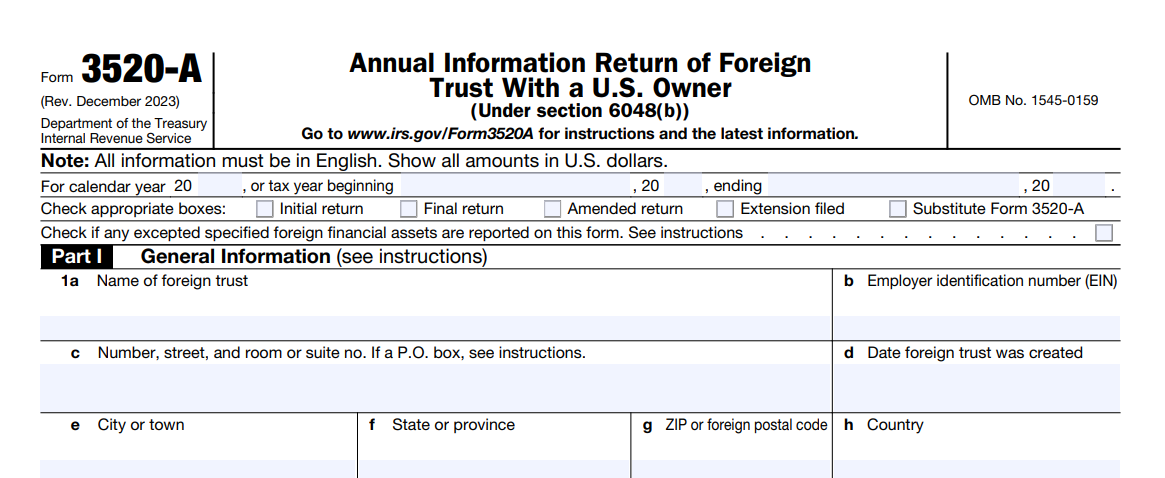
Form 3520-A is an IRS form required to report information about a foreign trust with a U.S. owner. For income tax purposes, it provides transparency into the trust’s activities, income, and foreign accounts during the trust’s tax year.
The foreign trust must file Form 3520-A annually as an annual information return of foreign trust with a U.S. owner. It discloses the gross value of the trust’s assets, its income, and any foreign gifts or distributions made to U.S. persons.
If the foreign trust fails to file the form, the U.S. owner must take responsibility for submission to ensure compliance. This obligation is non-negotiable under the grantor trust rules and the Internal Revenue Code.
Who Must File Form 3520-A?
The duty to file Form 3520-A usually lies with the trustee of the foreign trust. If there’s no U.S. agent, the U.S. person treated as owner must ensure it’s filed.
A U.S. person includes U.S. citizens, green card holders, and certain foreign persons classified as trust owners under the foreign grantor trust provisions. If a foreign grantor trust has U.S. beneficiaries or a U.S. owner, the U.S. person must verify that the foreign trust files on time
Not sure if you qualify as a U.S. person for tax purposes? Read our FAQ: Who Is a U.S. Person for Tax Purposes?.
When Is Form 3520-A Due?
The filing deadline for Form 3520-A is the 15th day of the third month after the end of the trust’s tax year — typically March 15 for calendar-year trusts.
You can request a six-month extension (to September 15) by filing Form 7004. This is different from your regular extension for the income tax return.
Missing the Form 3520-A deadline often results in the IRS assessing a substantial penalty during its initial processing of the late-filed return. Although reasonable-cause relief is legally available, the IRS may assess the penalty before granting that relief. The taxpayer must then request penalty abatement and, if the request is denied, may need to appeal the decision.
Form 3520 vs. Form 3520-A
Although related, Form 3520 and Form 3520-A serve different tax purposes:
- Form 3520-A – Filed by the foreign trust (or U.S. owner if the trust doesn’t). It provides detailed annual information on the trust’s income, foreign accounts, and trust’s assets treated as owned by U.S. individuals.
- Form 3520 – Filed by the U.S. person to report transactions with a foreign trust, foreign gifts, or other certain transactions.
Most U.S. persons with foreign trusts must file both forms for the same tax year.
Penalties for Failure to File Form 3520-A
Failing to file Form 3520-A on time, submitting an incomplete return, or providing incorrect information can subject the U.S. owner to an initial penalty. The initial penalty is generally the greater of:
- $10,000; or
- 5% of the gross value of the portion of the foreign trust’s assets treated as owned by the U.S. person at the close of the trust’s tax year.
Additional penalties may apply if the noncompliance continues for more than 90 days after the IRS mails a notice requiring compliance.
No penalty will be imposed if the taxpayer demonstrates that the failure was due to reasonable cause and not willful neglect. Reasonable-cause relief is not automatic and depends on the taxpayer’s particular facts and circumstances.
Can Form 3520-A Penalties Be Removed for Reasonable Cause?
Yes. The Form 3520-A instructions provide that no penalty will be imposed when the taxpayer demonstrates that the failure was due to reasonable cause and not willful neglect.
However, reasonable-cause relief is not guaranteed. The IRS evaluates the taxpayer’s specific facts, actions, and supporting documentation. Being a first-time filer or being unaware of the filing requirement does not automatically establish reasonable cause.
In our experience, obtaining relief from an assessed Form 3520-A penalty can be extremely difficult. Taxpayers should therefore address the filing requirement before the deadline and retain documentation supporting their compliance efforts.
Information Required on Form 3520-A
The foreign trust or its U.S. owner must provide detailed data, including:
- The foreign trust’s name, address, and taxpayer identification number (or employer identification number).
- A full accounting of the foreign trust’s assets and liabilities, showing the gross value at year-end.
- Income statements, balance sheets, and reports of foreign gifts, contributions, and distributions.
- Identification of each U.S. beneficiary and U.S. person treated as owner.
- The trust’s tax year, including all transactions and foreign accounts.
Providing incorrect information or leaving required sections incomplete can constitute noncompliance and may expose the U.S. owner to the Form 3520-A penalties described above.
Common Mistakes That Trigger Penalties
- Late filing form: Missing the filing deadline without an extension.
- Trustee confusion: Assuming the foreign trust’s local filings cover U.S. obligations.
- Incorrect information: Failing to report foreign gifts, foreign accounts, or foreign assets accurately.
- No Form 3520 filed: Forgetting that two forms are required for the same year—Form 3520 and Form 3520-A.
- Non-compliance with grantor trust rules: Misunderstanding the foreign grantor trust classification for tax purposes.
Avoiding these errors requires careful documentation and expert guidance in international taxation.
Why Form 3520-A Matters for U.S. Expats
For U.S. expats, understanding and properly filing Form 3520-A is essential for maintaining tax compliance and avoiding substantial penalties. The foreign grantor trust reporting rules apply even if no business income tax or certain business income tax is due.
To understand the broader compliance landscape, see our detailed guide:
Foreign Trusts Reporting: Tax Rules and Penalties for U.S. Expats
The form helps the IRS monitor foreign trusts, foreign gifts, and trust’s assets treated as owned by U.S. persons. Even small errors can lead to non-compliance, so working with a specialist ensures you file Form 3520-A correctly each tax year.

Get Professional Help With Form 3520-A
At 1040 Abroad, our expert guidance ensures your foreign trust or foreign grantor trust reporting is accurate, compliant, and on time. We help clients file Form 3520-A, Form 3520, and all related annual information returns to protect them from unnecessary costs.
Contact 1040 Abroad today to ensure accurate and timely filing and reduce the risk of substantial Form 3520-A penalties.


